
Table of Contents
- How the New Construction Home Buying Process Works in 2026
- New Construction Home Costs: What the Advertised Price Leaves Out
- Choosing a Builder and Comparing New Construction vs. Resale Homes
- Questions to Ask a Home Builder Before You Sign Anything
- New Construction Home Inspection Checklist for Every Build Stage
- New Construction Home Walkthrough Checklist: Your Final Walkthrough
- Construction Delays, Builder Contracts, and Your Buyer Protections
- Conclusion: Making a Confident New Construction Purchase
- Frequently Asked Questions
Last Updated: October 5, 2026
How the New Construction Home Buying Process Works in 2026
A new construction home is built from the ground up on a lot that has never held a house, and buying one follows a different path than purchasing an existing property.
The process moves through three phases: financing and budget, community and design selection, then contract, construction, and closing.
Phase 1: Budget, Preapproval, and Financing
Start with a mortgage preapproval before you visit a model home. Builders want proof you can close, and many will not hold a lot without it.
Budget beyond the purchase price. According to Consumer Financial Protection Bureau guidance on mortgage preapproval, comparing loan estimates from multiple lenders is one of the most effective ways to reduce your total borrowing cost.
Get preapproved before you tour communities. It sets your real ceiling and prevents falling for a floor plan you cannot finance.
Phase 2: Community, Lot, and Floor Plan Selection
Location drives long-term value more than any upgrade.
Lot selection matters as much as the floor plan. A premium lot may back to a preserve or water, and builders price that accordingly.
Then choose your home design and floor plan. Most builders offer a base plan plus upgrades.
Phase 3: Contract, Construction, and Closing
Once you choose, the builder presents a purchase contract. Read every term: deposit amounts, upgrade pricing, construction timeline, and contingencies. This is where a buyer representative earns their keep.
Construction begins after permitting. You will have scheduled walkthroughs during the build, then a final walkthrough before closing.
New Construction Home Costs: What the Advertised Price Leaves Out
The base price on a builder's flyer rarely reflects what you actually pay. New construction home costs stack in layers: lot premium, structural options, design-center finishes, builder fees, closing costs, and ongoing ownership expenses.
Use the worksheet below to build your all-in number before you sign, using the builder's written price list, your lender's Loan Estimate, and your county's tax rate.
The Full Cost Worksheet
| Cost line | What it covers | How to get the real number |
|---|---|---|
| Base home price | The floor plan as priced | Builder's written price sheet, not the flyer |
| Lot premium | Corner, cul-de-sac, water, or preserve lots | Ask for the lot premium map before you pick |
| Structural options | Added rooms, bumped walls, extra garage bay | Priced at contract, not at design center |
| Design-center finishes | Flooring, cabinets, countertops, fixtures, lighting | Request the full upgrade price list in writing |
| Landscaping and irrigation | Sod, trees, sprinklers, fencing | Often excluded; get a separate quote |
| Utility connections | Water, sewer, gas, electric hookups | Ask whether taps and impact fees are included |
| Builder administrative fees | Processing, HOA transfer, capital contribution | Request a written fee schedule |
| Property taxes | Based on assessed value after completion | Check the county assessor's millage rate |
| Homeowners insurance | Required from day one | Get a quote before closing, not after |
| HOA dues | Monthly or quarterly, plus reserves | Read the HOA budget and reserve study |
| Closing costs | Lender fees, title, prepaids, escrow | Compare Loan Estimates from at least two lenders |
| Move-in costs | Window treatments, blinds, water softener, mailbox | Budget several thousand dollars beyond closing |
How the Layers Add Up
The advertised base price and final contract price often diverge once lot premium, structural options, and design-center selections are added. The only reliable number is the one the builder puts in writing.
Two mechanisms drive most of the gap:
- Design-center pricing. Builders often require you to buy finishes through their design center, which limits comparison shopping. Ask for the full price list before you sign, and ask which items you can source yourself after closing (appliances, window treatments, and sometimes flooring).
- Allowances versus fixed pricing. Some builders give a design allowance and charge overages at retail. Others price each upgrade as a fixed line item. Fixed pricing is easier to budget; allowances hide the real cost until selection day.
Closing Costs and Escrow
Closing costs on a new build typically include lender fees, title insurance, prepaid taxes and insurance, and escrow setup. Under the TILA-RESPA integrated disclosure rules, your lender must provide a Loan Estimate within three business days of your application and a Closing Disclosure at least three business days before closing, per Consumer Financial Protection Bureau guidance on mortgage disclosures.
Escrow is not a fee but a holding account your lender uses to pay taxes and insurance. Your monthly payment includes an escrow portion, so the number at preapproval is not what you will pay after the county assesses the completed home.
Ongoing Ownership Expenses
Ongoing costs do not stop at closing. Property taxes, homeowners insurance, HOA dues, and utilities continue monthly. New homes are often more energy efficient, but landscaping, fencing, window treatments, and water softeners are usually not included. In many communities, the first-year tax bill is based on the unimproved lot value, then jumps once the home is assessed.
A Simple Way to Sanity-Check the Total
Add the base price, lot premium, structural options, design-center selections, and builder fees for your contract price. Add closing costs, prepaids, and move-in costs for your cash-to-close. Add the monthly payment, taxes, insurance, HOA dues, and utilities for your true monthly cost. If any of those three numbers is a guess, you are not ready to sign.
Choosing a Builder and Comparing New Construction vs. Resale Homes
Builder reputation should outweigh marketing polish.
New construction vs. resale comes down to trade-offs. A new-build home offers modern building standards, a warranty, and customization.
| Factor | New Construction | Resale Home |
|---|---|---|
| Condition | New, with warranty | Varies by age |
| Customization | Choose finishes | Limited to renovations |
| Timeline | Months to build | Weeks to close |
| Negotiation | Limited on base price | Often flexible |
| Maintenance | Minimal at first | Immediate possible |
For buyers who value certainty about systems and structure, new construction wins. For buyers who want to move quickly and negotiate price, resale often fits better.
Questions to Ask a Home Builder Before You Sign Anything
Ask about total cost, timeline, and warranty in writing before you commit. These questions separate a smooth purchase from a stressful one.
- What is the base price, and what is excluded from it?
- Which upgrades are structural versus cosmetic?
- What does the warranty cover, and for how long?
Get every answer in writing. Verbal promises do not survive a change of sales representative.
New Construction Home Inspection Checklist for Every Build Stage
A new construction home inspection checklist protects your investment at three points: pre-drywall, pre-closing, and final walkthrough. Hire an independent inspector, not one the builder recommends.
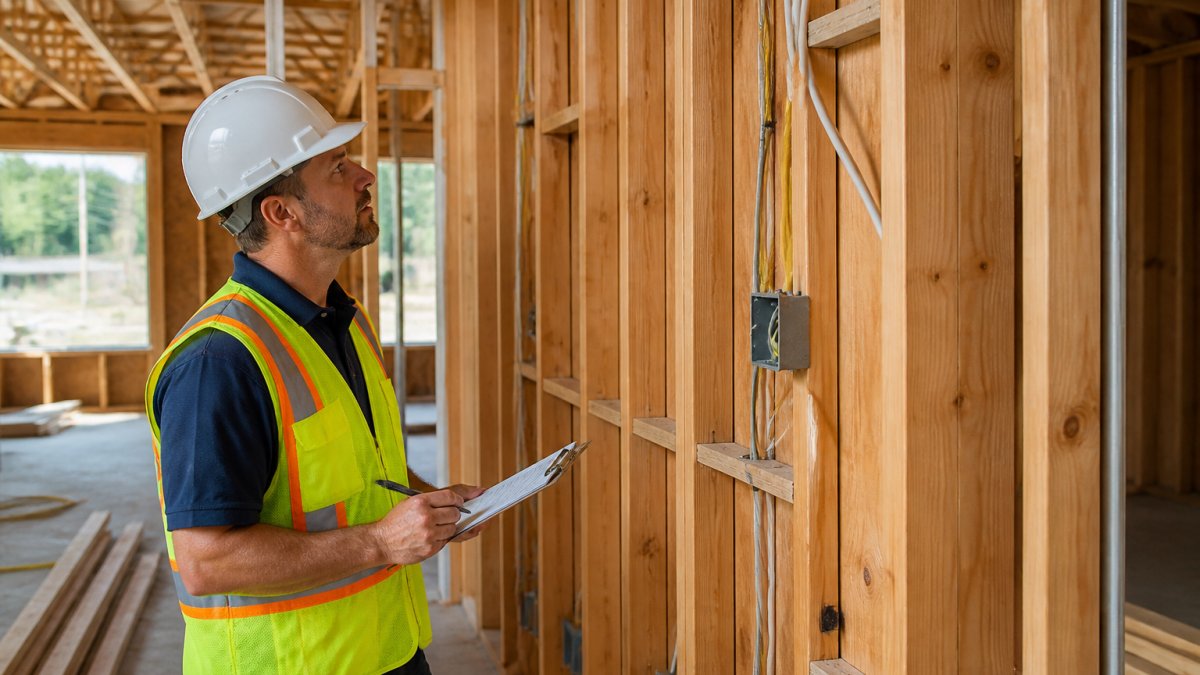
Pre-Drywall Inspection: What to Verify
The pre-drywall stage is your last chance to see what will be hidden. Verify framing, electrical rough-in, plumbing placement, and insulation before drywall goes up.
- Framing spacing and alignment match the plan
- Electrical outlets and switches are where you expect
- Plumbing lines are correctly placed and sealed
Final Inspection and Systems Testing
The final inspection tests everything that runs. Confirm the HVAC, plumbing, electrical panel, and appliances all function before closing.
- HVAC heats and cools in every room
- All outlets and fixtures work
- Water pressure and drainage are correct
New Construction Home Walkthrough Checklist: Your Final Walkthrough
Your new construction home walkthrough checklist is the last chance to document defects before you own them. Walk the home with your inspector and the builder's representative, and photograph everything.
- Test every light switch, outlet, and fixture
- Run all faucets and check for leaks
- Open and close every window and door
Anything not fixed before closing should be listed on a punch list with a written completion date. The U.S. Department of Housing and Urban Development guidance on homebuyer rights outlines what buyers can reasonably expect during the settlement process.
Construction Delays, Builder Contracts, and Your Buyer Protections
Construction delays happen, and builder contracts usually protect the builder more than the buyer. Weather, permitting, material shortages, and trade scheduling can push completion back by weeks or months. What matters is what the contract says about delays and what remedies you have.
Reading the Delay Clause
Most builder contracts include a completion window rather than a fixed date, plus a force majeure or excusable-delay clause listing events the builder is not responsible for, such as weather, labor disputes, material shortages, and permitting delays. Ask three questions:
- Is there an outside completion date, or only an estimate?
- Does the builder owe any compensation if the home is late?
- Can you cancel and get your deposit back if the delay exceeds a stated period?
Some contracts let the builder extend the timeline without penalty; others include a per-diem credit after a certain number of days. Get the answer in writing.
Rate-Lock Expiration and Delayed Closing
A delay can cost more than time. If your rate lock expires before closing, you may pay a higher rate or an extension fee. Ask your lender upfront:
- How long is the rate lock, and can it be extended?
- What does an extension cost, and who pays it if the builder caused the delay?
- Is there a float-down option if rates fall before closing?
Some lenders offer a longer lock for new construction, sometimes at a slightly higher rate. Compare that cost against the risk of an extension fee.
Change Orders: How They Are Priced and Approved
Every change after contract signing is priced and approved separately. Change orders add up fast, and the pricing mechanism matters. Ask:
- Is the change priced at cost plus a markup, or at a fixed schedule?
- Is there a change-order fee on top of the work?
- What is the deadline for changes before construction reaches that stage?
Get every change order in writing with a fixed price and revised completion date before work begins. Verbal approvals do not survive a change of sales representative.
Deposits, Cancellation, and What You Can Recover
Deposit structures vary. Some builders require an earnest deposit at contract and additional deposits at design selection. Ask whether each is refundable, and under what conditions. Common patterns:
- Earnest deposit refundable only if financing falls through under specific terms
- Design deposits non-refundable once selections are ordered
- Cancellation fees stated as a percentage of the contract price
Read the cancellation section carefully. If the contract lets the builder cancel and keep deposits, that is a risk you are accepting.
Independent Inspections and Your Right to Hire Them
Some builder contracts restrict third-party inspections or require the builder's preferred inspector. Ask before you sign whether you can bring your own inspector at pre-pour, pre-drywall, and final walkthrough. If the contract limits inspections, negotiate that term or walk away.
Warranty Coverage and How to Make a Claim
New-home warranties typically include a one-year workmanship period, a two-year systems period, and a longer structural period, though terms vary by builder. Ask for the written warranty document before contract, not after closing. Know:
- What is covered and what is excluded
- How to submit a claim and how long the builder has to respond
- Whether disputes go to arbitration or court
Your Practical Protections
Your protections come from the contract, the warranty, and your own documentation. A buyer representative reviews contract terms, tracks deadlines, and helps you document issues in writing. Keep a dated log of every conversation, change order, and delay notice; if a dispute escalates, that log is your evidence.
Conclusion: Making a Confident New Construction Purchase
Buying a new-build home rewards preparation. Set your budget before you tour, verify every cost beyond the advertised price, and inspect at each stage of construction.
At New Home Hub SWFL, we help buyers compare local builders, floor plans, and total costs before they commit.
Frequently Asked Questions
What is the process for buying a new construction home?
The process moves through three phases. First, you set a budget, get mortgage preapproval, and confirm what monthly payment you can carry. Second, you choose a community, lot, and floor plan, then review the builder's purchase contract carefully before signing. Third, construction begins, you complete inspections at key stages, and you attend a final walkthrough before closing. Each phase has deadlines, so tracking dates from the start prevents missed contingencies.
What costs should I expect when buying a new construction home?
The base price is only the starting point. Expect lot premiums, structural options, design center upgrades like flooring and cabinets, and builder fees that may not appear in the model home tour. Add closing costs, prepaid taxes and insurance, and any HOA or community development district assessments. Ask your builder for a written itemized cost sheet before signing, and compare it against your preapproval amount so the total stays within your financing limits.
Do you have to put 20% down on a new construction home?
No. Many buyers put down less than 20%. FHA loans allow down payments as low as 3.5%, and VA loans may require no down payment for eligible veterans and service members. Conventional loans can start around 3% for qualified buyers. A larger down payment reduces your monthly payment and may eliminate private mortgage insurance, but it is not a requirement. Ask your lender which programs fit your situation.
Should I get an independent inspection on a new construction home?
Yes. A municipal code inspection confirms the home meets minimum building standards, but it does not protect your interests the way an independent third-party inspection does. Hire your own inspector for a pre-drywall inspection before walls are closed and a final inspection before closing. The inspector documents defects in writing, which gives you leverage to request repairs before you take ownership.
What should I check during the final walkthrough of a new construction home?
Test every system: run all faucets, flush toilets, check outlets and light switches, and verify heating and cooling. Open and close every window and door. Look for cosmetic issues like scratched flooring, uneven paint, and cracked tile. Confirm that all agreed upgrades are installed as specified in your contract. Document every issue with photos and a written punch list, and get the builder's commitment to fix items before or shortly after closing.
How long does it take to buy or build a new construction home?
Timelines vary by builder, community, and home design. A quick move-in home that is already under construction may close in 30 to 60 days. A build from scratch often takes six to twelve months or longer, depending on permitting, material availability, and weather. Ask your builder for a written construction schedule with milestone dates, and build in a buffer for potential delays so your lease or move-out date does not create pressure.